| Tortuguero:
“region of turtles”
Exuberant, paradisiacal, mystical a natural network
of scenic and navigable waterways. One of the most exotic
and beautiful region of Costa Rica, rich in flora and
fauna.
Tortuguero is the most important nesting area for the
green turtles (Chelonia mydas) which come every year
to lay their eggs along this coast.
Tortuguero is one of Costa Rica’s best known
parks, and not without reason. It provides the visitor
a chance to view a diverse array of wildlife while traveling
by boat on a series of waterways, including a section
of the famous Limón to the Nicaragua border canal.
The canal was constructed in the 1930s to provide a
more economical and safe way of transporting timber
than the old method, which was to tie logs together
and tow them to Limón via the ocean. The park
protects examples of a surprisingly diverse array of
plant associations, including swamp forests, lowland
rain forests, and beaches. It’s also one of the
best places in the country to witness sea turtles nesting,
the beaches here being one of the most important sites
for the green sea turtle in the Caribbean.
Most of the park is low alluvial floodplain (sea level
to 20m) which extends far inland, and is occasionally
interrupted by isolated volcanic hills of 100, 300 m.
An intricate network of black water canals and creeks
dissect palm swamps and mixed rainforest throughout
the region. The natural vegetation of the area progresses
from the poorly drained swamp forests in the lowlands
near the coast to tropical wet and pre montane forests
further inland at higher elevations. Forest species
composition gradually shifts from coastal scrub to huge
expanses of Raphia palm swamp and mixed species along
waterway margins, to tall multi layered evergreen forests.
Canopy trees may exceed 60m in height with girths of
1, 2m, some with massive buttressing. Species diversity
of both plants and animals is very high here among the
highest in Costa Rica.
Abundant wildlife inhabits Tortuguero, including 57
species of amphibians, 111 species of reptiles, and
60 species of mammals. More than 300 species of birds
live in Tortuguero for all or part of the year. Birdwatchers
commonly see keel billed toucans, slaty tailed trogons,
Montezuma oropendulas and a variety of parrots. Birds
common along the canals include green and great blue
herons, egrets, belted kingfishers, anhingas, jacanas,
sun grebes and several species of hawks and kites. Other
animals commonly seen are fishing bats, three toed sloths,
iguanas, basilisk lizards, poison dart frogs, and howler,
white faced and spider monkeys. The tracks of river
otters, collared peccaries, and Baird’s tapirs
are often seen on the banks of rivers and canals. Caiman
are commonly observed in the waterways, which also are
home to gar fish, manatees, crocodiles, crustaceans,
and an occasional bullshark, Jaguars, ocelots, and kinkajou.
Other interesting species could be found here include
the endangered manatee, jaguar, and at least 309 species
of birds. Bird life on the canal is varied, so say the
least. Many species that are difficult to see in the
forest are much easier to observe. During the fall and
spring migration periods, spectacular numbers of North
American species pass through the area en route to South
America. These include orioles, warbles, and large numbers
of Swainson’s hawks. Permanent residents include
several species of kingfishers, herons, and rails. Less
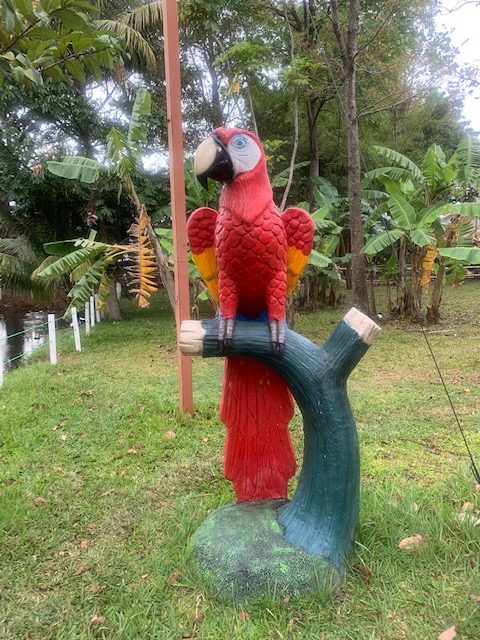
commonly seen species include the great green macaw,
which replaces the scarlet macaw of the Pacific side
of the country. Both species are endangered, and Tortuguero
is one of the great green’s last strongholds.
They can sometimes be seen crossing the canal, particularly
in the evening and early morning as they move from feeding
to roosting sites in raucous flocks of up to fifteen
individuals.
|