Soccer in Costa Rica
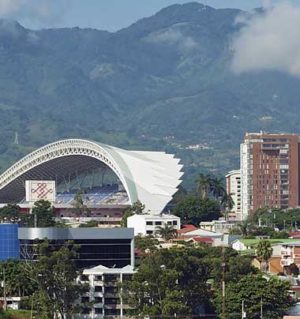
With the World Cup just a couple of months away the interest in soccer here is really heating up. In case you don’t know the Cup is held every four years and is the Super Bowl of soccer. This year’s edition of the cup will be held in South Africa. If you retiree in Costa Rica you are bound to become interested in soccer or fútbol as it is called in the Spanish speaking world. The game is almost a religion. Whenever there is a major soccer game, virtually everything comes to a stop and the party begins. Children of all ages can be seen playing soccer on the weekends. Adults even play informal games during their lunch breaks called mejengas.
Yesterday I watched a “clasicazo” (classic) soccer game with my son. It was between perennial powers Real Madrid and Barcelona. The latter won 2-0 marking the second time they have defeated Real Madrid at home. Barcelona is led by the superhuman Lio Messi who is considered the best player in the world. In Costa Rica we have a clasicazo which refers to games played between arch rivals Alajuela known as la liga and Saprisa know as the monsturo.
Here are the rules for soccer for those of you who are interested.
Basically, here is how soccer is played:
- Using a round ball, a soccer match is played by two teams wearing different colored shirts. Each team consists of not more than 11 players, one of whom is the goalkeeper. An official match may not start if either team consists of fewer than seven players.
- Up to a maximum of three substitutes may be used in any match played in an official competition organized under the auspices of the world governing body FIFA, the confederations or the national associations.
- In other competition, the rules must state how many substitutes may be nominated, from three up to a maximum of seven. The duration of an official match is 90 minutes played in two halves — each half lasting 45 minutes.
- The aim of the game is for one team to score more goals than the opposing team. The winning team is the team that has scored the most goals at the end of the game. Players score a goal when they succeed in moving the whole ball over the opposing team’s goal line, between the goalposts and under the crossbar. Players may use any part of their body except their arms and hands.
- The ball is out of play when it has wholly crossed the goal line, or touch line – whether on the ground or in the air, and when play has been stopped by the referee.
- The game is controlled by one referee on the playing field and two assistant referees placed on opposite sidelines.
- The field (or pitch) of play must be rectangular. The length of the touch line must be greater than the length of the goal line.
- Length: minimum 90 meters (100 yards), maximum 120 meters (130 yards)
- Width: minimum 45 meters (50 yards), maximum 90 meters (100 yards)
- International Matches
- Length: minimum 100 meters (110 yards) maximum 110 meters (120 yards)
- Width: minimum 64 meters (70 yards) maximum 75 meters (80 yards)
- The field of play is marked with lines. These lines belong to the areas of which they are boundaries. The two longer boundary lines are called touch-lines. The two shorter lines are called goal lines. The field of play is divided into two halves by a halfway line. The center mark is indicated at the midpoint of the halfway line. A circle with a radius of 9.15 meters (10 yards) is marked around it. A goal area is defined at each end of the field. A penalty area is defined at each end of the field. Goals must be placed on the center of each goal line.
Soccer vocabulary:
árbitro — referee
banda — sideline
cabezazo — header
cancha — field
defensores — defenders
delantero — forward
empate — tie
entrenador — coach
equipo — team
falta — foul
fuera de lugar — offside
fútbol — soccer
jugador — player
“Gooooooooooool! — Goal! — Said when some scores.
guardameta, portero, arquero — goalkeeper
marcar — to score
mediocampista — mid-fielder
mejenga — an informal pick-up game
mejengear — to play an informal pick-up game
partido, juego — game
pelota — ball
penal — penalty kick
penales— shoot out
primer tiempo — first half
saque — kick off
saque de banda — side throw-in
segundo tiempo— second half
tarjeta amarilla — yellow card (warning)
tarjeta roja — red card (expulsion)
tiro de esquina — corner kick
tiro libre — free kick
travesaño — cross-bar