Last week’s earthquake in perspective

The 1964 Alaska earthquake, also known as the Great Alaska earthquake,was the most powerful recorded earthquake in U.S. and North American history, and the third most powerful ever measured by seismograph; it had a moment magnitude of 9.2 and registered 8.4 on the Richter scale. I had some friends who had just moved there and they described it a a “living hell.”

Around 1970 there was a huge 7.9 quake in the Callejón de Huaraz area of Peru which killed over 30,000. I saw this area a few years later and it still showed the effects of this terrible disaster. The 1972 6.2 quake that flattened parts of Managua was the same intensity as the one that occurred here last week. The 1985  “big one” in Mexico City which killed thousands and was around  8.1. I visited there about a month later and the center of the city resembled a German city that had been bombed during World War II.

Despite all of the destruction and the people who lost their lives last week, we were very lucky because it could have been much worse. We count our blessings because we are alive and continue to live our retirement dreams unharmed. Fortunately, natural disasters and few and far between here.

I Feel Very Flattered

As most of the readers of my blog probably know by now, I have lived in Costa Rica almost 30 years and am considered to be the pioneer in the field of retirement and living in Costa Rica.

About 20 years ago the country and all it had to offer for retirees inspired me to write the first edition of my perennial bestselling guidebook, “The New Golden Door to Retirement and Living in Costa Rica.” Since that time I have written 15 more editions. Each one has been an improvement over the previous edition. Shortly after I published my first edition John Howells, a renowned travel writer, released the first edition of his book, “Choose Costa Rica.” Around 1995  another author published the “Official Guide to Costa Rica.” However, it was discontinued after four unsuccessful editions. It wasn’t until 2004 that Erin Van Reehen came to Costa Rica for a year to write the first edition of “Living Abroad in Costa Rica.” I had been approached a few years earlier by her publisher Moon Publications to discontinue  my guidebook and write the first edition of “Living Abroad in Costa Rica.”  When I looked at the numbers it just didn’t make sense and most of all I would lose creative control of the content of my book. Thus, I chose to keep writing and publishing my own book. Finally, in 2005 Tessa Borner published her book about living in Costa Rica entitled, “Potholes in Paradise.”

Around the year 2002 a new wave of gringo expatriates started to move to Costa Rica because of its popularity. Instead of being retirees this group consisted mainly of people in the thirties, forties and fifties who were looking for some way to make money here. Most went into real estate and tourism. While others tried their luck in the relocation retirement field where I had blazed the trail many years earlier.

By popular demand in 1997 I started monthly relocation/retirement tours. They were an immediate success. Since that time several other Americans from the new wave have copied my idea and formula and are offering similar tours. Other people have put up websites and made retirement videos trying to get their piece of the retirement market. However, since they don’t have my track record or experience none of them have ever really reached my level of success.

I really feel flattered and more successful than ever since almost all of these people have tried to adopt my time-tested formula. Needless to say there will be others who try to nudge their way into this niche market but with little success. I wish everyone the best of luck. Competition is good. It helps one perfect their product and become even more creative and successful.

Costa Rica Drop Outs in Panama and Nicaragua

In past articles about retirement in Costa Rica I have talked about all the country has to offer for Americans who want to move here: great weather, excellent health care, friendly people, NO army or terrorism, beautiful beaches, mountains and countryside, excellent housing options, an incredible lifestyle and a whole lot more. Unfortunately living here is not for everyone. I would be lying if I said it was.

Some people discover after living here for a while the country just isn’t for them. Most return to the U.S. but some choose to move to neighboring Nicaragua or Panama instead. What I have noticed is that the people who choose these country’s are usually the misfits from Costa Rica. Most often they are the ones who say they can’t afford  to live here and are willing to sacrifice Costa Rica’s great quality of life for a downgrade in the nearby countries. With the exception of two people, I don’t know any foreigners with a lot of money or who were successful here who moved to either Nicaragua or Panama.

Others who moved to the neighboring countries were troublemakers or couldn’t get along with anyone or just had to leave  because of legal troubles. One chap I met got involved with an under age woman and had to flee Costa Rica. Another guy represented an investment group that defrauded its investors. While another person was an alcoholic and  got into a lot of problems and made many enemies here.

I realize I am generalizing but what I just said is more the rule than the exception. Both countries seem to be receptacles for undesirable  Gringos with a lot of baggage.

Mother Nature Continues to bless Costa Rica

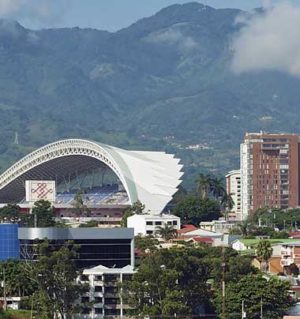
Some people were evacuated from their workplaces and some buildings in San Jose.

Some people were evacuated from their workplaces and some buildings in San Jose.

Almost all of the clients on my monthly relocation/retirement tours ask me about earthquakes. I tell them that since I have lived in Costa Rica I have felt an occasional tremor and been in two major earthquakes. Yesterday’s quake of 6.2 was the strongest of all of them. At 1:21pm Costa Rican time the earth shook violently.  The quake lasted 40 seconds, but seemed like an eternity. It affected some of the country’s infrastructure causing landslides and mud flows that swallowed entire sections of roads near the epicenter. Unfortunately a few people perished as a result.

Some parts of Mexico, Central and South America are earthquake zones. I am originally from California and have been in much stronger quakes there than yesterday’s big shake. I was in the Sylmar quake of the 70s and the San Fernando Valley quake of 1994. None of the quakes I have experienced here were as large nor nearly as deadly as the  California quakes.

In 1972 a 6.2 quake hit Managua, Nicaragua, leveled the city and caused thousands of  deaths. Yesterday’s quake in Costa Rica was the same intensity as the one in Nicaragua but in comparison only caused minimal damage. In 1985 there was a 8.1 earthquake in Mexico where thousands died and hundreds of building collapsed. I visited Mexico City shortly after that tragic event and the city looked like a German city after a World War II bombing.

Costa Rica is truly blessed because it  has been spared the wrath of the major hurricanes and devastating earthquakes which have occurred in the region during the last 30 years. So you should not let natural disasters be a factor when making your decision to retire or invest here.

Mexican “Bureaucrazy” worse than Costa Rica’s

A lot of Americans who retire in Costa Rica the country’s maze of bureaucratic is enough to drive them crazy. Mexico is another place many Americans choose to retire. Lately violence has reached epidemic proportions there which his scaring many potential retirees away. However, another factor the country’s endless bureaucracy  is another factor which may also contribute to driving potential retirees to away and to other countries like Costa Rica.

Read this article from the Los Angeles Times to get an idea of  how frustrating Mexico’s bureacracy can be.

Reporting from Mexico City — Arturo Sandria visited government agencies not once, not twice, not three times. (Hint: Try an even dozen.) He stood in mind-numbing lines, filled out forms, took another number, filled out more forms and, he says, paid $250 in bribes.

But after six months, he was still in pursuit of his prize: a permit to paint his house.

“Tedious,” Sandria declared of his paper chase. “They ask for a lot of things that aren’t really necessary.”

On a recent day, Sandria, a 50-year-old electronics technician, waited in (yet another) line at (one more) overcrowded government agency. He clutched a dogeared manila folder stuffed with documents outside a hulking downtown branch of Mexico City’s government, his 13th such visit.

“There could be three or four more,” said Sandria, a stocky man in a red Miami Heat jacket. “I could get up there and they could say, ‘You’re missing a check mark or a period.’ “

Sandria’s ordeal in red tape is excruciatingly familiar to many Mexicans, who long ago learned to weather a day-to-day obstacle course of bureaucratic requirements, or tramites (TRAH-mee-tehs), that would probably send most Americans into fits of hair-pulling.

As in the United States, there are tramites for opening a business, registering a car, building a porch. But what puts Mexican red tape in a league of its own are the reams of required paperwork — identification, proof of residence, birth certificates, deeds and titles — and a bureaucracy that can be as picky as it is ponderous.

Too often, many Mexicans complain, only bribes seem to get the creaky wheels of government turning.

So it stirred a sense of sweet vengeance when the government of President Felipe Calderon recently offered cash prizes in a contest to identify the country’s “most useless tramite.” An ad campaign depicted a haggard resident, laden with files, standing before a glowering bureaucrat.

Venting years of frustration, 20,000 Mexicans poured forth with nominations by Internet, telephone and even the postal system, which enjoys its own place in the nation’s pantheon of inefficient agencies. The winners, who will take home a total of nearly $50,000, are to be announced this month.

“The idea here is to have an assessment of tramites seen from the point of view of citizens,” said Salvador Vega Casillas, who heads the federal comptroller’s office, the Public Function Secretariat. “It is the first time the government is paying money to be criticized.”

Calderon, of the pro-business National Action Party, or PAN, says streamlining government and improving accountability will make Mexico more competitive, easier to live in and less prone to corruption.

The often-Kafkaesque requirements encourage residents to offer bribes as a way around the labyrinthine tramites. A study last year by the nonprofit group Transparency Mexico found that Mexico’s 105 million residents annually pay bribes totaling more than $2 billion, often for basic services such as getting a water line installed or garbage collected.

“This is the same amount of money we are spending on the whole federal judiciary system,” said Eduardo Bohorquez, director of Transparency Mexico. “This is a high burden.”

Many Mexicans express weariness born of years of wrangling red tape. Ni modo — what can you do?

But that is slowly changing as the country evolves from a sheltered regime, ruled for decades by the same party, to an emerging democracy more willing to embrace products and ideas from outside. The shift has brought genuine political competition and stirred residents to demand more from rulers. Or less, in the case of tramites.

“They say, ‘If I can get better service at the cinema, why can’t I get it from my government?’ ” Bohorquez said.

Despite Calderon’s call to slim down the government, today there are more than 4,200 federal tramites, nearly double the number in place before his conservative party took over from the Institutional Revolutionary Party, or PRI, whose 70-year rule ended in electoral defeat in 2000.

Officials say the big jump resulted from bureaucrats run amok as they sought to reshape the Mexican system, and from the PAN’s effort to codify government procedures after the PRI’s long rule, during which benefits were often doled out willy-nilly by local bosses.

Vega said officials hope to cut the number of tramites to 3,000 by the end of Calderon’s term in 2012 and to simplify them by allowing residents to fill out forms or make appointments online.

“We’re trying to return to a happy medium,” he said. “To streamline government, make it more accessible, cheaper to operate but also much nicer to the public.”

That last part shouldn’t be hard, given the burden that tramites impose on almost all Mexicans.

For example, pensioners have to report to a social security office every three months to prove to bureaucrats that they’re still alive. Villagers may travel five or six hours by bus to sort out a land-ownership issue, only to be told to come back another day. Registering a car or getting a taxi license can take days. Part of the reason Mexico City’s sidewalks are jammed with makeshift taco stands and card tables brimming with clothing, toys and hardware for sale is that many vendors want to skirt the headache of licensing a formal shop.

Mexican bureaucrats can be sticklers; scratching out a mistake on a form can send you back to the starting line.

“For me, it’s a way to justify the taxes we pay, to justify all the hiring,” Esteban Gasca, a 52-year-old economist, said as he left a federal passport office that is housed in the city government’s complex. He carried a manila folder and, despite the happy din of an office workers’ holiday party in the plaza outside, a less-than-festive expression. He was leaving empty-handed for the second day in a row.

The day before, Gasca had shown up at this branch, or delegacion, to get his passport renewed. But he was told his birth certificate had to be reissued on an updated form first. Another tramite, another line, another agency.

That done, he came back, only to learn that he’d been given the wrong hours for passport renewal. His plans to visit the United States this month were looking shaky. Gasca said he’d try to get the new passport at a different delegaciondelegacion, or come back one more time.

“You have to resign yourself,” he said.

Upstairs, in a bustling municipal office, a trio of colorful holiday-season piñatas offered scant cheer for two dozen residents waiting in a cramped corner for their chance to complete tramites at eight numbered desks. The whisper of shuffling papers was punctuated by the periodic shtunkshtunk of a clerk’s stamp: confirmation of a tramite accomplished.

Outside, Arturo Sandria waited with his folder of house-painting documents, including letters of permission from a city planning office and a federal agency that oversees the historic district where his house sits. Other people leaned against the wall, cradling their bundles of paperwork in folders and plastic sleeves. A woman in her 20s balanced a stack of files; she was holding a spot for her boss.

After four more hours of waiting, Sandria would triumph at last. His permit was approved, his tramites ended. He plans to start painting the middle of this month.

He’s settled on beige.