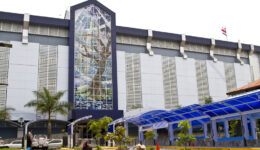

Retirees will be pleased to know there money is very safe with Banco Nacional

There are two types of banks in Costa Rica: Those owned by the state and private banks. Deposits are insured by the former and not by the latter. The only real disadvantage to public banks is that at times the lines and waits seem to be longer than at the private banks. I have accounts in both state-owned and private banks and prefer the former because my money is insured and the safety measures utilized by them.

For example, recently, the Banco Nacional, the country’ premier state-owned bank, opened a new state-of-the-art monitoring system (Centro de Monitoreo de Seguridad Electrónica) to protect its customers and facilities against robberies, fires and other potentially dangerous situations. The system receives information in real time from over 9,000 cameras at its branches and ATMs located all over the country 24-hours a day 365 days a year. In additional, all vehicles belonging to the bank are monitored by a satellite surveillance system.

Scotiabank is a Canadian financial institution and one of Costa Rica’s private banks. Scotiabank has branches located in more than 45 countries in the Caribbean and Central America, Mexico, Latin America and Asia. Unfortunately, in Costa Rica it is a private institution and does not insure its clients money as in Canada. Furthermore I once had a very unpleasant experience at a downtown branch of Scotiabank.

I opened an account there over ten years ago and also obtained a safety deposit box at the same time. On one occasion when I visited the bank I was asked to open my safety deposit box and show its contents to a bank official. Initially I refused but he showed me a contract I had originally signed which stated in fine print that the bank could inspect a client’s safety deposit box whenever it wanted. In addition, clients could not keep dangerous chemicals, firearms or CASH in their boxes. What kind of bank prohibits its customers from keeping money in a safety deposit box?

Anyway to make a long story short, when I showed the bank official what I had in my box he told me that I had to remove the cash immediately. I told him that I kept the money there in case of an emergency. He responded that I still had to remove the cash. I was really irritated and didn’t want to make a scene so I followed his instructions.

I took the money to The Banco de Costa Rica where I have another safety deposit box. While there I asked the person in charge if there were any restrictions about keeping cash in my box and he said , “NO”, another reason I prefer the state-owned banks.

To make a long story short I presented a complaint with the SUGEF, the country’s main banking regulatory agency, against Scotiabank because of the discourteous manner in which I is was treated. The bank and their rude employee ended up having to apologize to me in writing and in person. I thought about suing the bank but lawsuits take too long here.

Needless to say I never recommend Scotiabank to any of my clients, keep NO money there because of what happened to me and above all the fact that they don’t insure their customer’s funds.

Stars continue to fall over Costa Rica

I am not talking about meteor showers here but the number of celebrities who have visited Costa Rica in the last few years. The latest stars to cause an uproar are Angelina Jolie and Brad Pitt. Supposedly they will be vacationing here during Christmas and New Years. Furthermore, the couple is seriously considering purchasing a property in Costa Rica in order to spend more time here. Jolie was quoted as saying, “My children will need me a lot when they are adolescents. I will need to support them and spend as much time with them as possible during that stage of their lives.”

According to the British tabloid The Sun, “Brad Pitt has found a large piece of property and recognizes that it would be the perfect place for a family hideaway. The country fascinates him and he would like to have a place to spend time when his career winds down.”

On another front Miley Cyrus, of Hannah Montana fame, recently visited the country with her boyfriend, Liam Hemsworth.

Over the last couple of years such luminaries as Mathew McConaughey, Leonardo Dicaprio, Tom Brady and Guisele Bundchen, Bill Gates, Steven Seagal, Steve Tyler, Michael Jordon and others have visited Costa Rica to view the country’s natural wonders and vacation here. Mel Gibson owns a lot of property and frequently hangs out here.

Despite the popularity of the Costa Rica with the rich and famous, ordinary travelers and potential retirees make of the bulk of visitors to the country. Regarding the latter, Costa Rica is still the most desirable retirement haven in Latin America and because of its friendly people, great year-round weather, affordable medical care, tropical flavor and so many more intangibles.

A good medical experience at Costa Rica’s Clínica Bíblica

Costa Rica’s private hospitals are excellent. I have had nothing but good experiences at both the Clínica Bíblica and Cima hospitals. Most of the specialists I see work at the former. In fact, I have been going there for over 25 years. I have had two hernia operations, arthroscopic surgery on my knees and several colonoscopies at the Bíblica and cannot complain about the care my family and I received over the years.

Recently, I experienced some digestive discomfort. I went to see Doctor Longworth, who is my main family physician. He examined me, prescribed a treatment and told me to call him in a week if I didn’t feel better. A week passed and I still had some discomfort, so Dr. Longworth referred me to Dr. William Pérez Martinez, who is a gastroenterologist. After talking with Dr. Pérez, he decided to schedule an ultrasound of my abdomen just to play it safe.

The next morning I arrived at the hospital with an empty stomach as the doctor requested. I waited about 20 minutes until they called my name and had the procedure done. During the examination the doctor let me look at the screen while he moved a camera-like device around my abdomen. He explained everything he was doing step-by-step and told me what kind of shape my kidneys, liver, spleen and pancreas were in. Fortunately, he didn’t find anything abnormal. I breathed a sign of relief when I heard the good news. The who procedure took about ten minutes. I had to wait another fifteen minutes for the results and then returned to the office of Dr. Pérez. He looked at the report of the ultra sound and told me not to worry. It turned out that I had a mild case of colitis and had to make some dietary changes. The doctor told me what not to eat so as to not exacerbate the condition and prescribed a some pills which I have to take for a week.

I am very happy because I didn’t have anything seriously wrong with me and feel fortunate that I live in a country which has such a good healthcare system. Retirees and other foreigners who move here can have peace of mind knowing that the quality of health care is excellent and affordable.

Renewing my Costa Rican Passport, a good experience with the country’s bureaucracy

One of the biggest complaints voiced by retirees in Costa Rica is that dealing with the country’s bureaucracy is a real pain in the butt. In many cases this is true especially when dealing with the country’s immigration department or “Migra” as it is called in local slang.

The office that handles residency is located right off the main highway in an area called La Uruca, about ten minutes from downtown San José. Going there can be like a journey into hell or a black hole. The place is a real mess with many people’s files scattered all over without any rhyme or reason. Unfortunately, anyone who applies for residency for the first time has to go there.

However, it is an entirely different story when you have to renew your residency cédula (ID card) since you can now do it at many of the Banco de Costa Rica’s (BCR) branches for a cost of about $60.

I have been a Costa Rican citizen for over ten years so I don’t have to renew my residency, but I do have to renew my Costa Rican cédula every ten years and do it through the Registro Nacional. Recently I had to renew my Costa Rican passport which can now be done at the Banco de Costa Rica.

The first step is to call 800-227-2482 to schedule an appointment. I made my appointment by phone in a couple of minutes. I was told that I had to get photocopies of the front and back side of my Costa Rican cédula as well as the first two pages of my expired Costa Rican passport and take them to the bank on the day of my appointment.

My appointment was at 9 AM when the bank opened. Within five minutes they called my name and the process began. I paid $62 dollars, had to have a fingerprint photo taken of each of my index fingers and have a photo taken of my face for my new passport. The whole process took about ten minutes.

They told me that the post office would deliver my passport to my home within ten work days. I learned that in Costa Rica not to count on things being done punctually. Much to my surprise my passport was delivered by a courier exactly one week to the day of my appointment at the bank. I guess Costa Rican bureaucracy does not live up to its bad reputation in some cases or perhaps the quality of service is improving.

Retirees Will be Happy to hear Costa Rica 4th In Least Corrupt In Latin America

Despite falling 9 positions in one year Costa Rica is still the fourth least corrupt country in Latin America behind only Chile, Uruguay and Puerto Rico. This according to Transparency International’s Corruption perceptions index which measures the perceived levels of public corruption inn 183 countries around the world.

Costa Rica is ranked 50 in the world. New Zealand ranks first, followed by Finland and Denmark. Somalia and North Korea are last.

Nicaragua, Paraguay and Venezuela are the most corrupt countries in Latin America. Venezuela is considered to be the most corrupt of all.

The index scores 183 countries and territories from 0 (highly corrupt) to 10 (very clean) based on perceived levels of public sector corruption. It uses data from 17 surveys that look at factors such as enforcement of anti-corruption laws, access to information and conflicts of interest.

In Central America, Nicaragua is 134th overall with a score of 2.5, Panama 86th with 3.3, El Salvador 80th with 3.4, Honduras 129th with a 2.6 and Guatemala in 120th place with a 2.7.

In South America, Colombia ranked 80th overall with a score of 3.4, Venezuela 172nd with 1.9, Brazil 73rd with 3.8, Argentina 100th with 3 and Chile, the least corrupt of all Latin American countries, placing 22nd overall ad with a score of 7.2.