Puntarenas the New Riviera

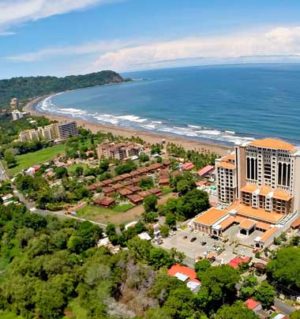
Before Guanacaste’s string of beaches was accessible and Costa Rica’s southern zone opened up, the port town of Puntarenas enjoyed its heyday. El Puerto as it is affectionately called by the ticos (Costa Ricans) was the main beach destination for Costa Ricans from the Central Valley for more than a century. In fact, thirty or forty years ago Puntareanas was the tourism epicenter of Costa Rica. The town’s long beach, a seaside palm-shaded promenade called el Paseo de los Turistas with its series of souvenir kiosks, open-air bars and inexpensive have always been a magnet for the locals.

This port city is the best places in the country to savor fresh seafood, including chuchecas (ink-black clams). In fact, the people who live in Puntarenas are affectionately called chuchequeros. Some of the best marisquerías or seafood restaurants in the country are found all along the Paseo de los Turistas. Puntarenas is also the home of another local delight called the Churchill, a beverage similar to a snow cone over which layers of syrup and ice cream are poured.

In the 1990s the town suffered a decline because of a crime problem, many unsavory characters and its dirty beach. Fortunately, everything has changed in recent years and the town has been reborn. The seven-mile brown-sand, palm studded, beach has been cleaned up and now included in the ”Blue Flag” category. All of the recent improvements have led this beach town to be renamed the “New Riviera.” The new Caldera Highway has added to the boom by virtually cutting the driving time in half from the Central Valley.

A new way to pay your yearly property taxes in Costa Rica

Previously there were only two ways to pay your annual property taxes. You could go to the municipality office near your home and pay or you could pay though the on-line pages of these Costa Rican banks: LAFISE, Banco de Costa Rica, Banco Nacional and Bancrédito, provided you had an account at one of them.

However, now you can also pay by Internet using the new system of direct debit. This system is called Sinpe or Sistem Nacional de Pagos Electrónicos (National System of Electronic Payments). The advantage is that you no longer have to have an account in one of the banks I mentioned above. Payments can now be made through any Costa Rican bank where you have an account. The process is surprisingly easy. You go to the municipality and authorize them to deduct the money from your account.

This is the type of insider information you learn on my monthly relocation/retirement tours.

You may live longer by Moving to Costa Rica

If longevity depends on lifestyle then living or retiring here may just what you need.

Few people know that Costa Ricans are among the world’s leaders in life expectancy.Their life expectancy for both men and women is higher than that of the United States. The average life span in 2009 was 79.3 years. Although women outlive men, the overall life expectancy of 79-plus years puts the country in the world’s upper echelon regarding longevity.

Costa Ricans are the happiest people in the world according to a recent study and this may be the main reason for their longevity. Other contributing factors may be their lifestyle, cradle-to-grave health care system, diet, care-free-live-for-today outlook on life, a lack of stress or some other intangible. Whatever the reason you can probably prolong your life by moving here. I personally know scores of foreigners who say they never felt better after relocating here. Many, in jest, say that it must something in the water that makes them feel so good. I would venture to say that it boils down to the lifestyle. There is something uplifting about living in this fantastic country. People feel revitalized. You would have to spend some time here to understand exactly what I mean. Those who have moved here can surely relate to it.

I always try to convey the above to the participants on my monthly relocation/retirement tours as one of the most compelling reasons to relocate here.

Costa Rica’s first-class health care system

Costa Rica’s first-class health care system is drawing more and more people from the United States – even the rich and famous.

Costa Rica is more than ever for medial tourism and all of the celebrities know about it. On my world-famous, monthly relocation retirement tours I talk about the quality of health care in Costa Rica. I take my clients to visit the country’s two premier private hospitals and we go into depth about the country’s health care system at our highly-informative two-day seminar. Below is an excerpt which talks about the quality of the country’s health care. People who relocate here should not have to worry about their health concerns here. I have had many clients on my tours who have come here specifically to take advantage of the country’s low-cost medical care.

San José, Costa Rica – Conservative talk-show host Rush Limbaugh said this week he’d go to Costa Rica for medical treatment if Congress passes proposed reforms to the US healthcare system. That might sound like an unusual choice, since this is a country with one of the longest standing socialized healthcare systems on the planet. Everyone here (including resident foreigner), are required to pay into the government-run health system, whether they use it or not.

But Limbaugh’s choice may also serve to advertise what many Americans traveling here for medical treatment already know: Costa Rica is a fabulous place for medical tourism.

Life expectancy in this little Central American country surpasses that of the United States and at one point, back in the early 2000s when the World Health Organization rated countries’ general health, Costa Rica ranked higher (No. 36) than its northern neighbor (No. 37), despite spending 87 percent less on health care per capita. Some who’ve studied Costa Rican health care consider it better overall, and attribute that to the fact that free coverage extends to 86.8 percent of the population.

But the Cadillac-style private hospitals at Chevy Aveo prices are what really draw 25,000 Americans to Costa Rica every year.

“People travel to Costa Rica (and) receive the same quality of medical services for a fraction of the cost,” said Jorge Cortés, president of the Council for International Promotion of Costa Rica Medicine and medical director of Hospital Biblica, one of three internationally-accredited private hospitals in Costa Rica. “When people see they can get the same surgery for three or four times less, they decide to get medical care abroad.”

Lower labor costs and fewer malpractice suits keep the prices down here. In Costa Rica’s private system, a teeth-cleaning might run $40 and a general check-up costs $50.

Medical bargains

More extensive surgeries? A facelift averages $2,800 to $3,200 in Costa Rica, compared to $7,000 to $9,000 in the United States. A knee replacement may cost $11,000 in Costa Rica, but can be as much as $45,000 in the United States.
But there’s another arm of the country’s medical system – the public system – which is relied upon by a majority of the population. While celebrated by Costa Ricans for “universal access,” it’s often criticized for long wait times and delays in treatment.

“There’s a difference between the healthcare system that serves people living in Costa Rica verses that which is known to foreigners,” said Robert Book, a healthcare economist for the conservative think tank, the Heritage Foundation. “It’s the private option for foreigners that Mr. Limbaugh was referring to when he said he would go to Costa Rica.”

On Tuesday, Mr. Limbaugh clarified his comment about leaving the United States, after “the liberal media” celebrated his vow of self-imposed exile, viewing healthcare reform as a way to rid themselves of the conservative talk show host.
“If I have to get thrown into this massive government health care insurance business and end up going to the driver’s license office every day when I need to go to the doctor, yeah, I’ll go to Costa Rica for treatment, not move there,” he told listeners Tuesday, according to a transcript on his website.

Mr. Cortés said Limbaugh would not be alone in traveling abroad for medical care. He’s expecting medical tourism to increase by 5-7 percent over the next year, regardless of what happens with the US healthcare reform bills.
Booming business and that increase is building upon a growth Costa Rica has already seen. Since the recession forced many Americans out of jobs, Costa Rica has seen a surge in the number of their northern neighbors coming here for health services. In fact, there’s an entire industry catering to the medical tourist, including post-surgery spa services, sightseeing packages, hotels, and transportation.

But, if Limbaugh did move to Costa Rica and chose to initiate the process of residency, he’d be required to pay into the government-run social security system – which runs the health care system too. Under law, all people employed in Costa Rica must contribute 5.5 percent of their salary to the state-run social security system and employers are required to match their payment with 9.25 percent. Even those here for retirement are obligated to contribute under new immigration laws, regardless of whether they hold private insurance.

“The strengths of our health system (is) that it is universal, that it’s based on the idea of solidarity and that it’s fair,” says Dr. Ana Morice, vice health minister in Costa Rica. “What we need to improve is access to health services. Many times someone requests an appointment and doesn’t receive it until a year later. In that area, we have much to improve.” Of course, if Limbaugh decided to move to or buy real estate in Costa Rica, he wouldn’t be the first celebrity. His neighbors might include actor Mel Gibson, model Gisele Bundchen, AOL executive Steve Case, or Vice President Joe Biden’s brother, Frank.

The Golden Years are Now

The other day I talked to a friend who has lived here for about twenty years. I hadn’t chatted with him for about a year, so we spent time catching up on things. He has an elderly mother in the States who is on her last legs. We got talking about old age and the so called “golden years.” My friend was quick to point out that we are in the golden years now because we are in good health. He is 100% correct!

I feel very lucky to have moved to Costa Rica 30 years ago. Every year has been a “golden year” in this marvelous country. I really feel blessed to live here. On my most recent monthly relocation and retirement tours all of my guests told me the same thing. After seeing all that the country has to offer, my clients said that I was extremely fortunate to have made the correct decision to come here to live.

I gave up a lot when I cam here; a career, security and a whole lot more. But everything worked out because I followed my dream and it came true. Others can do the same if they fall love with the country. Costa Rica just may be the solution to what ails you in your home country. The have a saying here, “Costa Rica cures it all.”

Pura vida!