
Despite falling 9 positions in one year Costa Rica is still the fourth least corrupt country in Latin America behind only Chile, Uruguay and Puerto Rico. This according to Transparency International’s Corruption perceptions index which measures the perceived levels of public corruption inn 183 countries around the world.
Costa Rica is ranked 50 in the world. New Zealand ranks first, followed by Finland and Denmark. Somalia and North Korea are last.
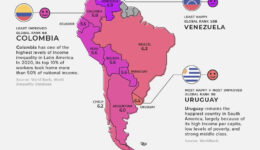
Nicaragua, Paraguay and Venezuela are the most corrupt countries in Latin America. Venezuela is considered to be the most corrupt of all.
The index scores 183 countries and territories from 0 (highly corrupt) to 10 (very clean) based on perceived levels of public sector corruption. It uses data from 17 surveys that look at factors such as enforcement of anti-corruption laws, access to information and conflicts of interest.
In Central America, Nicaragua is 134th overall with a score of 2.5, Panama 86th with 3.3, El Salvador 80th with 3.4, Honduras 129th with a 2.6 and Guatemala in 120th place with a 2.7.
In South America, Colombia ranked 80th overall with a score of 3.4, Venezuela 172nd with 1.9, Brazil 73rd with 3.8, Argentina 100th with 3 and Chile, the least corrupt of all Latin American countries, placing 22nd overall ad with a score of 7.2.
Baby Boomers who are thinking of retiring in Costa Rica will be pleased to know that the country’s infrastructure will continue to be developed and modernized despite the world economic crisis, thus improving the quality of life here. During the last couple of years Costa Rica completed two major highways despite the world’s economic ills: One to the Pacific port of Caldera and another between Quepos and Dominical also on the Pacific Coast. A new airport terminal in also being built in Liberia, Guanacaste in the north. Now plans have just been announced to double the size of Juan the Santamaría airport, the country’s main airport located in the city of Alajuela.
One hundred and fifty three million dollars will be invested in the airport’s new passenger terminal. This new terminal will be 22,000 square meters in size, will include nine lounges, as well as an area of stores of at least 3,300 square meters. It will be located to the west of the actual terminal and is part of third and fourth phase of the expansion project of the airport. The new terminal will be financed with around $150 million dollars provided by the Banco Interamericano de Desarrollo (BID) – Inter-American Development Bank.
With the expansion, Juan Santamaría airport will have a total of 18 boarding rooms, all with their respective boarding bridges. Construction is scheduled to begin during the first half of 2013. Once the expansion is complete, the airport should be able to handle more than seven million passengers yearly. The current facilities handles about three million passengers entering and leaving Costa Rica each year.
Small investors and retirees should not worry about investing safely in Costa Rica. I have written about this topic repeatedly and feel obliged to do it again for my readers to reassure them that it is safe to invest here.
Amazon.com, Proctor and Gamble, MacDonald’s, Intel, medical technology companies and others have all poured millions of dollars into Costa Rica over the last decade. Now more big players are doing the same because of the countyr’s political stability, stellar international reputation and it’s highly educated work force. Just look at the commitment Wal-Mart just made and what it will do for the local economy.
Wal-Mart’s executive vice-president for Central America, Alberto Ebrard, just announced the company’s plans to open 24 new stores this year as part of a $160 million investment in the country. This move will create over 800 new jobs for Costa Ricans. The chain currently operates a total of 181 retail units that include 6 Hipermas megastores and 25 Mas x Menos, 15 Maxi Bodega and 135 Pali supermarkets. Wal-Mart has a total of 531 stores in Guatemala, El Salvador, Honduras, Nicaragua and Costa Rica employing 30.000 people.
In addition, the company’s plans is to open a Hipermás megastore in Alajuela this year. In case you don’t know, these humungous warehouse-style stores closely resemble the average Wal-Mart store in the U.S.
None of the large companies mentioned in this article would invest here if they thought for a minute there was a chance of losing their investments. Consequently retirees and other small investors should have no qualms about making real estate investments after doing their due diligence. Costa Rica will continue to draw large companies, tourists, investors and retirees for years to come.
Retirees and other small investors should not worry about investing in Costa Rica. Big international companies continue to have confidence in the country and continue to invest millions of dollars here.
Intel plans to invest 8 million dollars in its Engineering Development Center (CID) to develop software. The new center will have 300 employees.
Hewlett Packard recently chose Costa Rica as one of its new hubs to give support to clients all over the world.
It was just announced that two new hotels will be built west of San José. The first will be located on the grounds of the Forum II in the La Lindora area of Santa Ana. The second will be built in Guachipelín, Escazú near the Intercontinental Hotel. About 15 to 20 million dollars will be invested in each project.
In addition, Grupo Universal who runs a chain of department stores recently announced it would build an office complex across the street from the northwest corner of the Sabana Park. The structure will be built on the site of the present Universal department store.
Investment continues to flourish because of the county’s highly educated people, its stability and growth. All of this has been despite a world economic crisis.
Due to the demand of a growing expatriate retirement community and health tourism, the Clínica Bíblica just announced that it will expand its downtown facility in San José. Since 1929 the hospital has had a tradition of meeting medical needs of the Costa Ricans and expats. As part of its expansion plans to keep pace with the country’s needs for first-rate private care, the hospital built a multi-storied medical tower in the adjacent block and added a large wing to the main hospital during the last ten years.
Now the hospital will invest $15 million in a new structure to the south of the main building according to Bernal Aragón the hospital’s general director. The structure will have a six-level parking structure for more than 1000 vehicles. The seventh level will have a heliport with a capacity for four helicopters at the same time.
In case you don’t know The Clinica Bíblica (Tel:2522-1000, 800-911-0800, Fax: 2255-4947,E-mail:asoserme@racsa.co.cr, www.clinicabiblica.com) is affiliated with the Blue Cross and Blue Shield network. There is a small chance that Medicare may be accepted someday, but don’t hold your breath. A first-class private hospital with an excellent coronary unit, this fine facility is staffed with highly trained doctors. Complete hospital services including maternity, an ER room, MRI equipment and lab work are available. My family and I have used the hospital’s service for over 25 years found the service to be excellent.
Other private medical facilities in the greater metropolitan area are: Hospital/Hotel La Católica, Hospital Jerusalem, Clínica Santa Catalina, Clínica Santa Rita and the new kid on the block, Hospital-Clínica metropolitana.
I always make it a point to talk about medical care options in Costa Rica during my month relocation/retirement tours and the many lectures and conferences where I speak.