
Good Economic news for retirees and others thinking of investing in Costa Rica

Courtesy of Inside Costa Rica

Retirees and others should have no qualms about investing in Costa Rica. Here is what the country’s president says about our economy.

Costa Rica’s economy is expected to post solid growth of 4.5% this year and 5% next year as the country continues to invest in infrastructure and open up the telecommunications industry.

“We are efforting this push into Asian markets to increase the rate of growth. We have a very ambitious program,” said Costa Rica’s Presidenta, Laura Chinchilla, on the sidelines of the United Nations General Assembly in New York.

Known for its eco-tourism and coffee production, Costa Rica will boost growth by improving infrastructure such as ports, and by opening and promoting markets such as electricity and telecommunications.

Costa Rica has trade agreements with China, Singapore and the European Union bringing the amount of free trade agreements to 42 and increasing trade to 92% of total exports. It is also starting negotiations with South Korea.

Chinchilla, the first woman president and just four months in government after succeeding Nobel laureate winner Oscar Arias, is set to increase competitiveness by continuing to educate and train its population of more than 4.6 million.

Costa Ricans take pride in the fact that they are the only country in the Americas without an army, and 50 years ago established free education — a competitive advantage difficult to emulate in a short period of time.

With a skilled work force, and political and social stability, Chinchilla’s government hopes to capture us$9 billion in foreign direct investment over the next four years.

In 2009 inflows of FDI reached $1.3 billion of which 57% were from the United States. Most of the inflows go to manufacturing, real estate, services, and tourism.

Economic growth has come from the services sector with 60 percent of gross domestic product, industry with 32% and agriculture with 8%.

“Today, after serious trade policies based on the promotion and diversification of exports and the attraction of foreign direct investment as key elements, Costa Rica exports more than 4,116 products to 135 countries around the world, with a net worth of us$8.675 billion,” Chinchilla said.

“Our total exports have increased over 60 percent in the last decade,” she said. Imports however, reached us$11.4 billion in 2009.

Chinchilla also stressed security and prevention of the high levels of organized crime that other neighboring countries have experienced as one of her key issues in her domestic agenda.

“We are trying to design a regional agenda in terms of security issues,” Chinchilla said. “Our homicide rate is relatively low. We are just trying to prevent what has happened in other regional countries.”

In terms of bond issues, the president of Costa Rica’s promotion agency, Jose Rossi, said it would be favorable for the finance ministry to issue global bonds as global interest rates are low and as Costa Rica’s credit rating was raised to investment grade earlier this month by Moody’s.

The country has us$1.25 billion in outstanding debt, divided into five different global bonds, one of them maturing next year. If and when the country issues, Rossi said part of the money will go to repay the maturity due, projects in infrastructure, education and other debt issues with multilaterals.

Starbucks is coming to Costa Rica soon

I know some people aren’t thrilled to hear this news because it seems that there is a Starbucks on every corner in the United States and in many other countries in the world.

The company that has the franchise rights to Central America will open its first cafés in El Salvador. It is expected that they will be expanding to the neighboring countries within a year or two. Personally, I like some of the products Starbucks offers but find them too expensive. In Costa Rica we already have cafés that are similar like Port Java and the Mac Cafés found inside many of the local MacDonald’s restaurants. The latter actually make a better frappachino coffee than Starbucks. You’d have to try one to understand what I am talking about. I have had many people on my monthly retirement tours try a frappachino at the local Mac Café and agree with me 100%.

Costa Rica’s New Paper Money

When retirees and especially tourists come to Costa Rica, it usually takes them some time to used to dealing with the local currency called the, colón. Just when newcomers are getting used to making purchase with Costa Rican coins and bills a big change was announced.

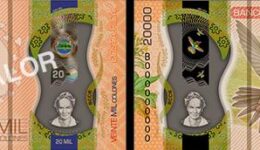
Today all of Costa Rica’s major newspapers featured pictures of six new bills that will come out this year. The bills have been totally redesigned for the following denominations: 1,000, 2,000, 5,000, 10,000, 20,000 and 50,000 colones. In addition, to a completely new design on the front and the back, each bill will be a different size and color.

The new bills are made of a cotton fiber-based paper and sensitive to the touch. If you turn the bill the map of Costa Rica on the front changes color.

Bills that have nicknames like “un rojo” for 1000 colones because of its red color and “Un Tucán” for 5000 colones because of the bird on it, will now look totally different. For example, The 5,000 bill have a picture of ex-president Alfredo Gonzáles Flores on one side and a tropical motif on the back.

The 20,000 colon bill will be the first one released around in August. The 2,000 colón bill will be the second one to come out in September or October. The rest will start to circulate after that. The Central Bank will wait to see how the 20,000 colón bill is accepted by the public before they release the 50,000 colón bill.

More good news about Costa Rica

Last week two articles appeared extolling the Costa Rica’s beauty. The first was by Gill Williams and appeared in England’s The Mirror. The second article was by Gisela Williams and appeared in the New York Times.

It seems that the only time you hear about Costa Rica is in news articles and TV documentaries about the country’s national parks, beaches, volcanoes or other national wonders. There is never anything negative in the news like you hear about Cuba, Venezuela, Colombia, Nicaragua or Mexico.

Costa Rica’s stellar reputation is what makes it popular with tourists and retirees. The latter are flocking to the country as the quality of life and economy continue to deteriorate in the United States. Costa Rica has more retirees from U.S. per capita (proportionately) than any other country outside the States. These numbers speak for themselves. Costa Rica has become a brand name for retirement abroad.

Indications are that economic crisis in Costa Rica is almost over

People who are thinking of taking my tours should do so now since I read in today’s newspaper that the conomic crisis is almost over in Costa Rica. Our little country has recovered faster than the United States.

All indicators point out that the economic crisis is slowly coming to an end and the country is recuparating. Supporting that is the fact that there have been 35.995 new jobs created between August 2009 and January 2010.

The figures were released by the Caja Costarricense del Seguro Social (CCSS).

A poll by Manpower shows that Costa Rica is the number two in job expectations in Latin America, with a 23% net gain in jobs.

Other indicators that the economic crisis is almost done and over with is the fact that 40.000 people attended the 10 days of the Expomóvil, the annual car show, that is really one big open ten saleathon for new and used vehicles.

Add to that is the report by the Camára Nacional de Turimso (Canatur) that hotels and tour operators report an 80% occupancy rate for this Semana Santa.

And the Cámara de la Construcción is predicting a 13% increase in new hiring that translates into 15.000 new jobs in the sector.

Of course those who lost their jobs in the past year see it totally different.

The price of consumer goods, clothing, groceries, appliances, etc. is still the same, while their income took a drastic drop. The economic crisis affected greatly the lower middle class to the lower class, which are still reeling from the effects and don’t see the positive side like the other classes.

However, experts in economy say the country is coming out of the crisis and there will a strong increase in hiring in the coming two years.

According to the Univesidad Nacional (UNA) economist, Roxana Morales, in October 2008 there were 1.391.129 employed, in January 2010 the number of employed rose to 1.405.299 or 14.170 more people employed.

Also, the monthly economic index produced by the Banco Central shows that the economic activity in January 2010 was 6% higher than in January 2009.

Economic experts suggest that the use of credit cards be reasonable and keeping financial order is important, as well as not speculate on the future movements of the dollar/colon exchange rate.